If you lead a sales team right now, you've probably added AI somewhere: prospecting, call notes, email drafts, forecasting. You're not alone. What may surprise you is how few teams are seeing it pay off.
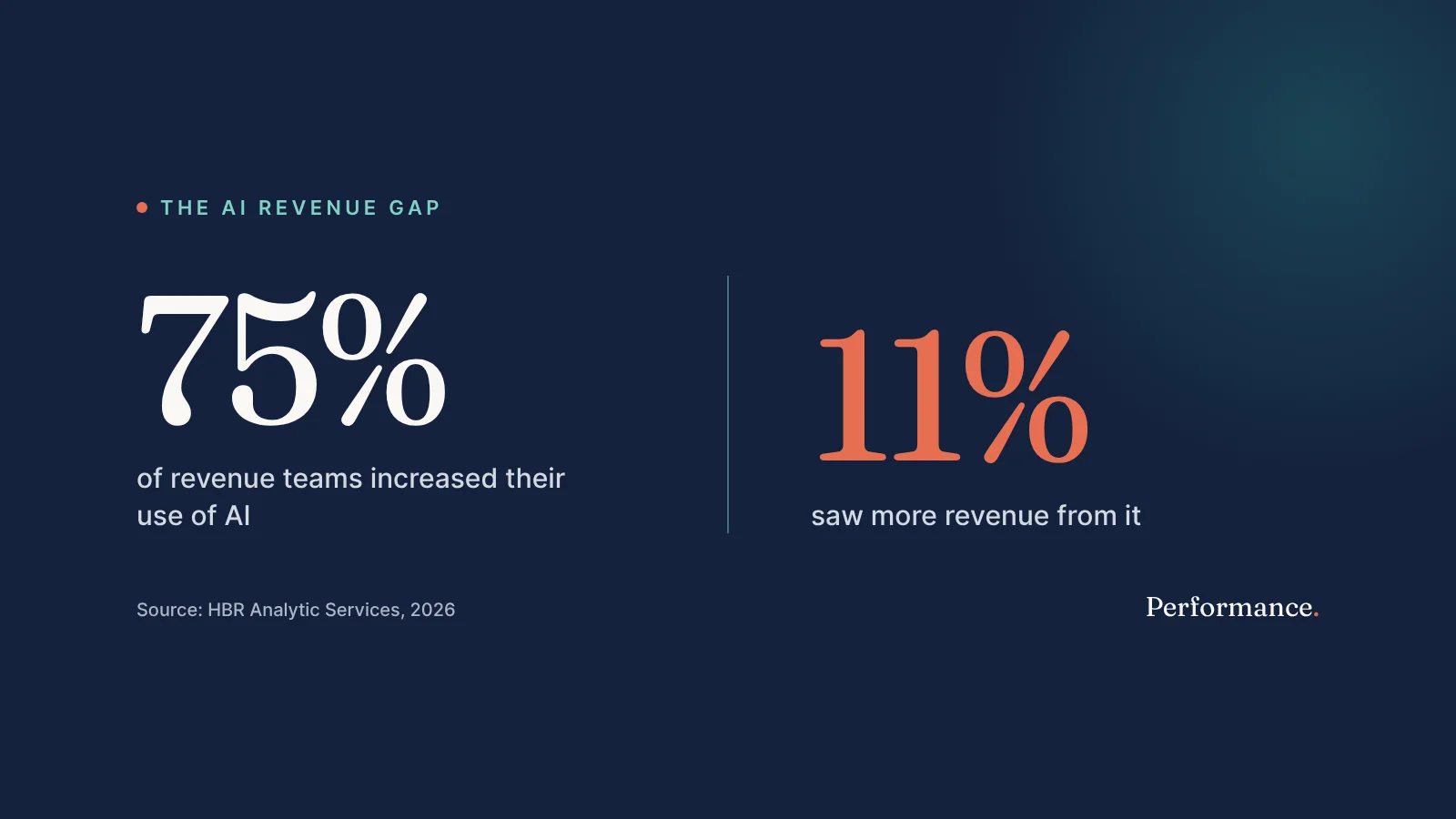
A new Harvard Business Review Analytic Services report, sponsored by Seismic, surveyed 208 senior business leaders. Three in four said their organization had increased AI use for revenue-generating work over the past year. Only 11% said it had increased revenue. The top barrier wasn't budget or technology. It was the lack of a clear AI strategy.
That gap between adoption and results may be the most important sales story of the year. The good news is that it's fixable, and the fixes aren't technical.
The problem isn't the tool
When AI doesn't move revenue, the reflex is to blame the tool and shop for a better one. But AI is a multiplier. Put it on a strong sales process and it multiplies what works. Put it on a fuzzy one and it multiplies the confusion.
If your team doesn't agree on what a qualified lead is, an AI prospecting tool will fill your pipeline faster with deals that stall. If discovery calls are inconsistent, AI call summaries will document the inconsistency very efficiently. Speed only helps if you're headed in the right direction.
Map the deal before you automate it
Harvard Business Review made a similar point this month: companies see real gains from AI when they map their workflows end to end, find the constraint, and redesign around it. Automating one task at a time doesn't get you there.
We saw this when Diagnocat, a European dental AI company, prepared to launch in the US. It had strong traction in Europe but no US sales process, no follow-up playbook and no automation. Before building anything, we measured everything, including the time from lead to demo, which no one had been tracking. That one number showed where to focus. From there we built the sales process, the follow-up playbook, coaching for the team and HubSpot automations. The result was more demos, more deals and a growing pipeline.
For your team, start by walking one real deal from first touch to signed contract:
- Where does momentum usually slow down?
- Who owns each handoff, from marketing to SDR to AE to customer success?
- What has to be true for a deal to move to the next stage?
For a deeper look at which numbers to baseline first, see What to Measure Before Scaling AI in Healthcare Sales.
Give your team a clear AI policy
Strategy also means saying out loud how you want people to use AI. A recent study in The Leadership Quarterly found that managers trusted employees less when they had used AI on a task, but the penalty disappeared when the organization openly encouraged AI use.
On a sales team, silence leads to two bad outcomes. Some reps quietly avoid tools that could help them. Others use them and hide it. Neither builds a team that learns. A one-page AI guideline fixes this. It should say where AI is encouraged, where a human must stay in the loop, and how to share what's working.
Train the skills AI can't fake
AI can draft an email. It can't build trust on a discovery call, notice hesitation in a buyer's voice, or handle an objection with empathy. Those human skills become more valuable as everyone's outreach starts to sound the same.
Practice is where those skills grow. In a 12-practice dental group we worked with, consultants were trained in empathetic listening and handling objections, then coached using their own recorded consultations. One consultant who had been close to being dismissed doubled her case acceptance and collections.
Athletes watch game film. Sales teams should too. Recording role-plays and real conversations (with permission), then reviewing them together, lets reps hear what buyers hear. Managers can coach specific moments instead of general impressions.
What to do this week
You don't need a six-month transformation to start closing the gap:
- Pick one recent deal you won and one you lost. Walk both timelines with your team and mark where they split.
- Name your biggest constraint. Lead quality, discovery, follow-up or handoffs. Choose one.
- Write your AI guideline on one page. Share it in your next team meeting and invite questions.
- Record one role-play. Practice the conversation tied to your constraint, then review it together.
- Only then, point AI at the constraint. Pick one use that directly supports the fix, and measure it for 30 days.
The bottom line
The teams that win with AI won't be the ones with the most tools. They'll be the ones with a clear process, a clear policy and people who keep getting better at the human side of selling.
If your team has added AI and you're still waiting for revenue to follow, start with the process underneath it. And if you'd like a second set of eyes, a Sales & Strategy Assessment is a good place to begin.
Where do your deals stall today?
Sources
- New Study Finds AI Adoption Surging Across Go-to-Market Teams, but Revenue Gains Lag Behind, Business Wire via Yahoo Finance, Nov 4, 2026
- For Real Performance Gains with AI, Start by Mapping Your Workflows, Harvard Business Review, Nov 2026
- Using ChatGPT at Work? Your Boss May Trust You Less, New Study Finds, Hebrew University of Jerusalem via EurekAlert!, Nov 4, 2026